The escalation of the Iran conflict has rattled global markets.
Oil prices have surged above US$100 a barrel as the Strait of Hormuz, one of the world’s most important energy routes, remains heavily disrupted. Around 20% of global oil and gas supply typically flows through this region, so it’s no surprise markets have reacted sharply.
For Australian investors, this has meant a spike in volatility across shares, higher inflation concerns, and renewed questions around interest rates and the cost of living.
Whenever geopolitical shocks like this happen, it’s natural to feel uneasy.
But it’s important to remember that market volatility is a normal part of investing.
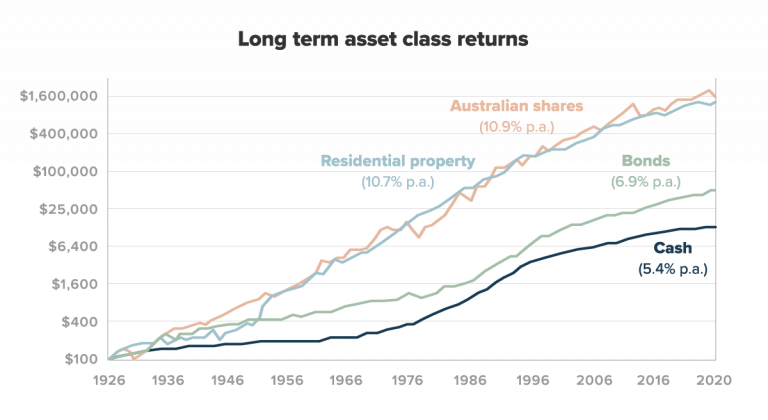
Over the past century, markets have navigated wars, recessions, political crises and energy shocks, yet long-term investors who stayed disciplined have historically been rewarded. Australian shares have still earned investors on average 10.9% p.a. since 1926, so it pays to stay invested and be patient.
The biggest risk during periods like this often isn’t the market fall itself.
It’s the mistakes investors make in response.
Here are the 6 most common investing mistakes to avoid during the current market turbulence.
Mistake #1: Selling in panic because the headlines feel overwhelming
This is by far the most common mistake.
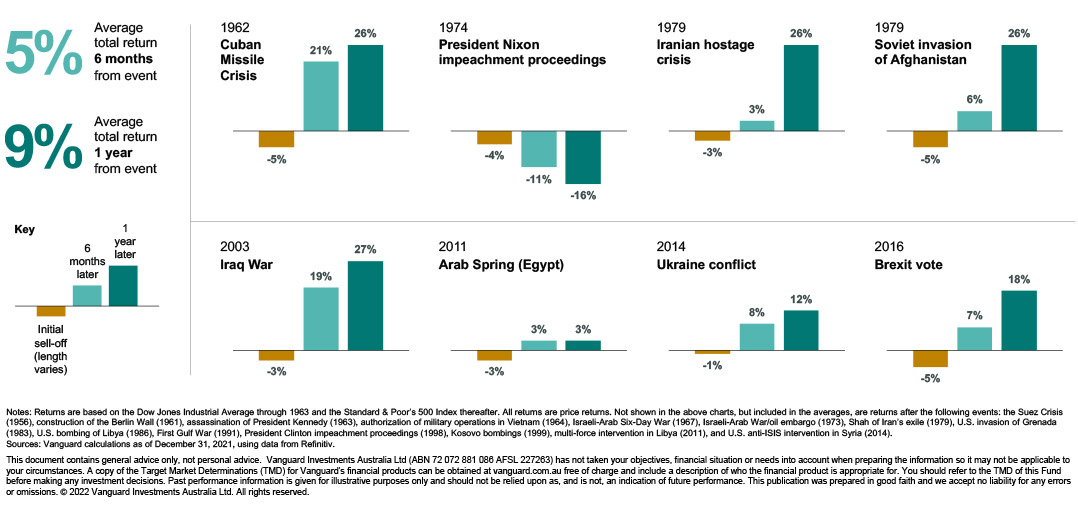
When markets fall sharply during geopolitical events, it can feel like the safest thing to do is sell and wait for things to settle. But history shows markets often recover before the news flow improves.
By the time headlines start sounding more positive, markets may already have rebounded significantly.
We saw this during Brexit, the COVID crash, the Russia-Ukraine invasion and previous Middle East conflicts.
Markets tend to move ahead of the economy and ahead of the headlines.
Selling after markets have already fallen locks in losses.
Then you face a second challenge, deciding when to buy back in.
That means getting two decisions right instead of one – and even professional investors struggle to do that consistently.
The better approach is usually to stay invested and stick to your long-term strategy.
A Vanguard study of 22 major geopolitical events found that, on average, markets delivered positive returns 12 months after the initial shock.
Mistake #2: Changing your investment strategy in response to short-term events
Periods like the current Iran conflict can make a previously sensible portfolio suddenly feel too risky.
That emotional reaction is understandable.
Behavioural finance shows that losses feel roughly twice as painful as gains.
A diversified portfolio that felt comfortable a month ago can suddenly feel wrong. But changing your risk level after markets have already fallen is effectively another form of market timing. It often means selling the assets that have already declined the most.
That’s rarely a good long-term decision.
Unless your life circumstances or goals have changed, short-term geopolitical events alone usually aren’t a reason to change your investment strategy.
Mistake #3: Not topping up when markets are on sale
If you have spare cash reserves and your emergency buffer is in place, market dips can actually be an opportunity. This is where it helps to reframe what’s happening.
When retailers run a Black Friday sale, people rush to buy things they already wanted at a lower price.
But when the share market goes on sale, many investors do the opposite.
They run for cover.
That’s purely psychological.
For long-term investors, lower prices can improve future returns. Regular investing through periods like this can be particularly powerful. It means you continue buying at lower prices, which helps lower your average purchase price over time.
This is especially relevant now as volatility is being driven by short-term uncertainty around oil supply and inflation expectations rather than a collapse in the long-term earnings power of businesses.
Mistake #4: Forgetting the role of dividends and distributions
Even when share prices fall, many companies continue paying dividends.
Those dividends can be incredibly valuable during downturns.
When reinvested, they buy more units at lower prices.
That means more exposure to the eventual recovery.
Over time, this can significantly improve compounding.
It’s one of the reasons long-term investors often recover faster than they expect after market falls.
Mistake #5: Not rebalancing your portfolio
One of the biggest themes of the current market environment is sector rotation.
Higher oil prices are benefiting energy and commodity-related exposures, while growth sectors and interest-rate-sensitive assets have come under pressure.
This is exactly why portfolio rebalancing matters.
Rebalancing forces you to sell assets that have outperformed and buy assets that have fallen.
In other words, it systematically helps you buy low and sell high.
Importantly, it removes emotion from the process.
At times like this, your emotions often tell you to do the exact opposite.
That’s why automatic rebalancing can be so powerful.
Mistake #6: Not diversifying your investments
This is where diversification really proves its worth.
When geopolitical tensions rise, different assets respond differently.
Technology shares may fall. Oil and energy-related shares may rise.
The current conflict has reinforced the value of holding assets that respond differently to economic shocks.
No single asset is a perfect hedge. But a diversified portfolio reduces the risk that any one event, sector or country determines your outcome.
That matters enormously during periods like this.
At Stockspot, we prepare for uncertainty and dips in the market by investing across a broad range of different investments.
The bottom line
The Iran conflict is clearly unsettling markets.
Higher oil prices, inflation concerns and uncertainty around global growth are all contributing to the volatility we’re seeing right now. But market falls during wars and geopolitical crises are not new.
For long-term investors, the biggest mistake is often reacting emotionally.
The investors who tend to achieve the best outcomes are usually the ones who stay calm, stay diversified and stay invested.
Short-term volatility feels uncomfortable but long-term discipline is what builds wealth.