When sharemarkets aren’t doing much, active fund managers are supposed to earn their keep.
That’s the pitch, anyway.
A skilled manager should be able to avoid the expensive parts of the market, find overlooked companies and move away from sectors that are about to struggle. When the index is barely moving, good stock selection should make a bigger difference.
The first half of 2026 should’ve suited active funds
Australian shares returned just 2.4%, but beneath that fairly dull result there were huge differences between sectors. Materials and energy delivered double digit gains, while healthcare fell 21.9% and technology lost 15.7%. Large companies also did much better than smaller ones.
There were plenty of opportunities to get it right, yet most active managers didn’t.
The latest SPIVA Australia Scorecard found that the average actively managed Australian share fund returned just 0.2% in the first half of 2026, compared with 2.4% for the S&P/ASX 200.
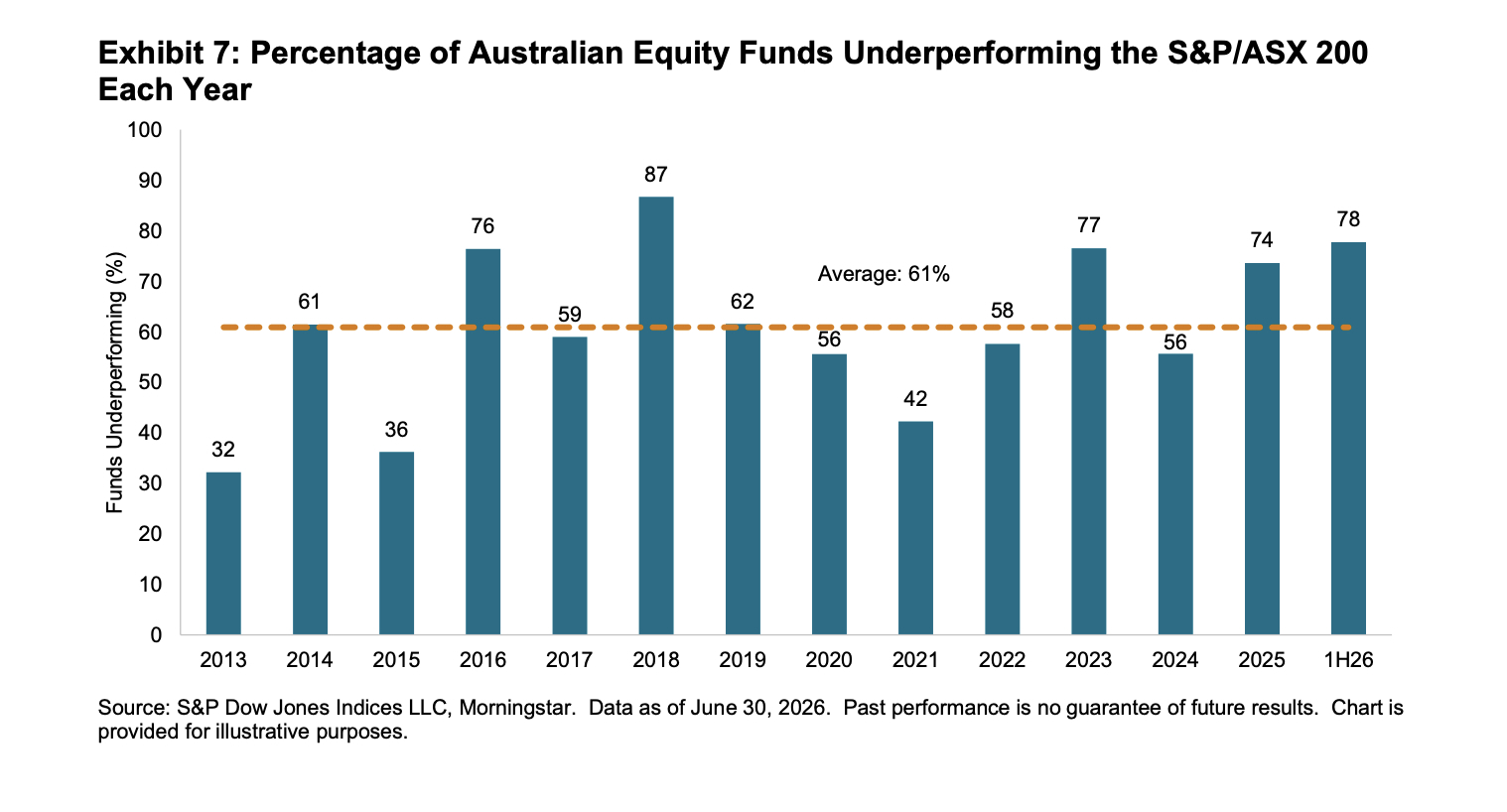
Almost four out of five active Australian share funds failed to beat the market. If that continues for the rest of the year, 2026 will be the second worst year for active Australian share funds since SPIVA started measuring them in 2013.
I’ve worked in investing for more than 20 years and I’ve heard countless versions of the same argument. Index investing is fine when markets are rising, but when things get difficult you need a good active manager who can separate the winners from the losers.
It sounds reasonable but the evidence keeps saying otherwise.
The first half of this year wasn’t a market where everything moved together. The gap between the winners and losers was unusually wide, which should’ve given active managers more room to show their skill. Instead, most of their decisions ended up costing investors money.
Part of the problem was that only 35% of companies in the S&P/ASX 200 beat the index. The largest 20 companies also grew to represent more than 63% of the market.
That makes picking winners harder than it sounds. An active manager can own plenty of decent companies and still fall behind because they missed a handful of the biggest performers, or simply didn’t own enough of them.
Index investors don’t need to guess which companies will lead the next rise because they already own them. That won’t make for a thrilling investment story in the newspaper, but over time it has proved very difficult to beat.
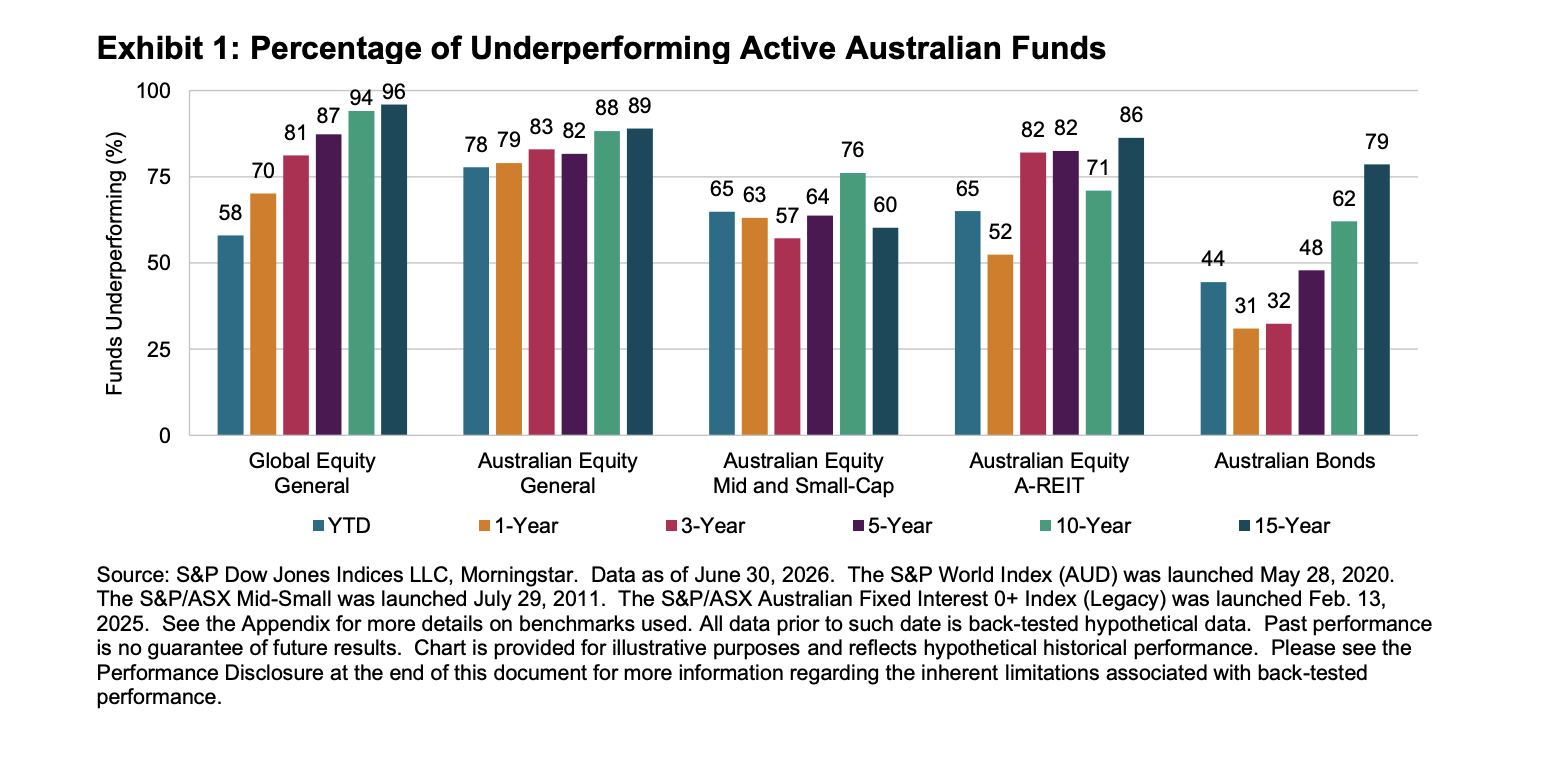
The longer term results are even more damning. Over 15 years, 89% of Australian share funds underperformed the index, while among global share funds the figure was 96%.
This isn’t one bad year or an unlucky stretch. It’s a pattern that has persisted through different governments, interest rate cycles, market crashes and recoveries.
Australian bond managers did slightly better in the first half of 2026. The average active bond fund returned 2.4% compared with 2.3% for the index. However, stretch the timeframe to 15 years and almost 79% still underperformed.
Then there are the funds that disappear
More than half the funds that existed at the beginning of the 15 year period had closed or merged by the end. Investors rarely hear much about those because the winners stay on the website, while the failures quietly vanish or get folded into another fund.
That’s one reason the SPIVA study is useful. It counts the funds that didn’t survive, which gives a much more honest picture of the choices investors actually faced at the beginning.
Of course, some active managers will beat the market. There will always be a few, and their recent performance will usually be well advertised.
The hard part is finding them before they outperform. Looking at last year’s winners is easy, but working out whether their success came from skill, luck or one large bet is much harder.
Even if you choose correctly, you still need to know when the manager has lost their edge. Perhaps the market has changed, key people have left or too much money has flowed into the fund. By the time it becomes obvious (like happened at Magellan), the damage is usually already done.
The latest SPIVA report also found something investors should pay more attention to. The cost of choosing a poor manager can be much greater than the reward from picking a good one.
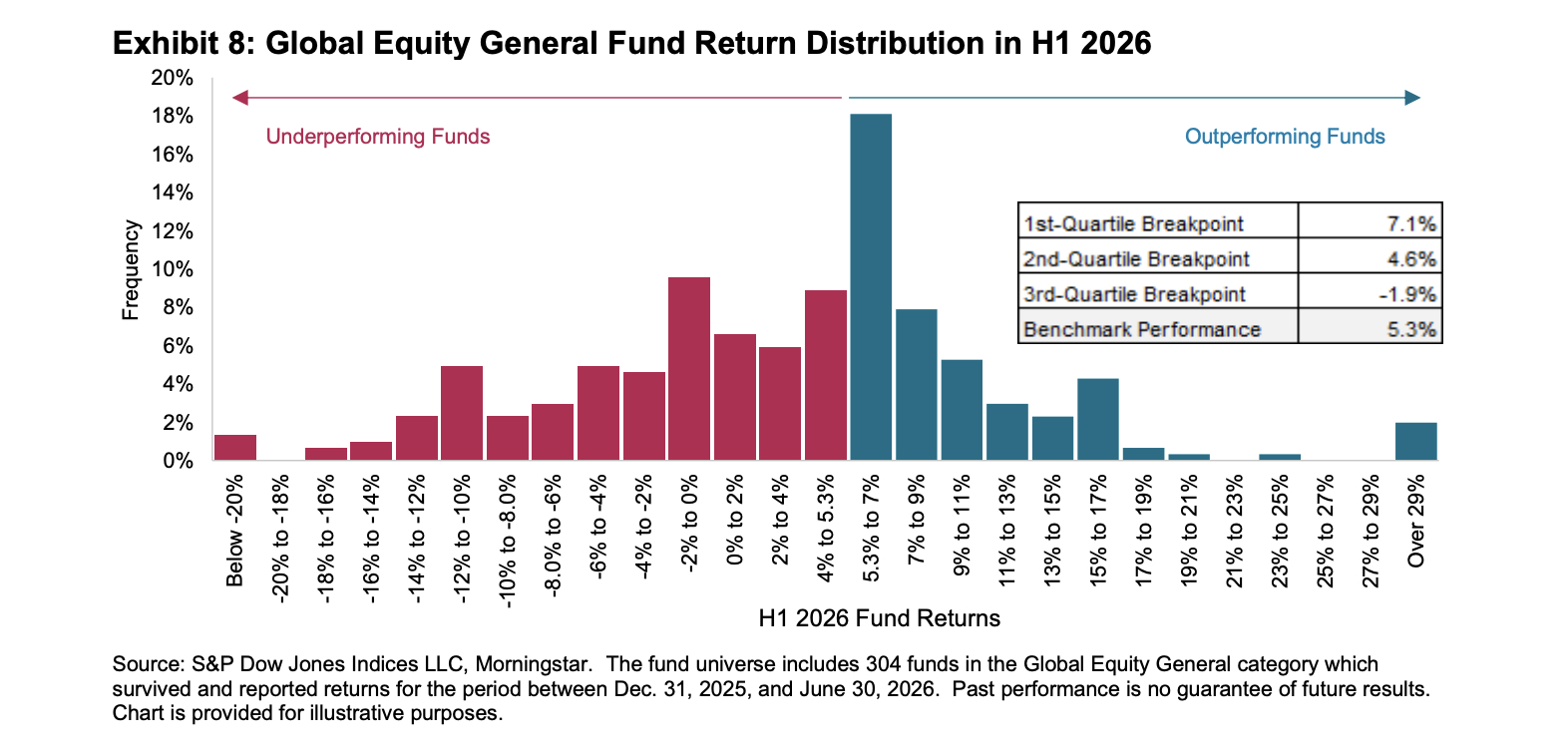
Among global share funds, the top quarter beat the index by at least 1.8% during the first half. The bottom quarter trailed it by at least 7.2%. In other words, the downside from getting the decision wrong was much larger than the upside from getting it right.
Active managers also start with a handicap because their higher fees come out every year, whether their decisions are right or wrong. They don’t simply need to beat the market. They need to beat it by enough to cover those extra costs, and then keep doing it.
From 1 July 2027, that hurdle is about to get higher again
Under the government’s announced capital gains tax reforms, a minimum tax rate of 30% will apply to real capital gains accruing from that date, subject to the final rules and limited exceptions.
That makes turnover more important. Active fund managers regularly buy and sell investments as they change their views, which can realise capital gains that are passed through to investors. From 2027, those gains could create larger tax liabilities for many investors in active funds.
Low turnover index ETFs should have an even stronger advantage. They usually make fewer trades, realise fewer gains and give investors more control over when they trigger capital gains tax. Tax has always been one of the less visible costs of active management. Soon it could become much harder to ignore!
This is likely to support the continued growth of index ETFs. Investors won’t just be comparing fees and performance. They’ll also be looking more closely at how much unnecessary tax activity is happening inside their fund.
This is why Stockspot has invested exclusively in low cost index ETFs since we started. We’re not pretending we can identify next year’s winning fund manager, sector or company because I don’t believe anyone can do that reliably.
Index investing will never beat the market, but that’s not the goal. The goal is to capture as much of the market return as possible without handing a large share of it to fund managers, tax costs and unnecessary trading along the way.
Markets will always have disappointing periods, and investors can’t control that. What they can control is how much they pay, how well diversified they are and whether they avoid chasing last year’s winners.
Most importantly, they can stay invested.
The investment industry loves making simple things sound complicated because complexity helps sell expensive products. The latest SPIVA results are another reminder that investors usually don’t need more activity or clever predictions.
They just need fewer expensive mistakes.