Why would you take the risk of investing when savings accounts and term deposits offer rates above 5 per cent? It’s a question we keep getting from our clients as more of them divert money they would have invested into savings accounts, cash ETFs or their mortgage offset instead.
A mortgage offset is particularly appealing for many working people because you’re effectively earning a return without paying tax on it. With most home loan rates now at 6 per cent or higher, it’s a difficult hurdle for shares or ETFs to beat consistently, after-tax.
Add to that the looming capital gains tax changes, which will increase tax for investors and add an administrative nightmare from mid 2027. It’s no wonder more money is flowing into the simpler, savings alternatives.
When interest rates are high, shares can perform better
However, our research suggests investors could be moving away from shares and ETFs just as interest rates approach their historical sweet spot. Our figures challenge the idea that an attractive interest rate is automatically a reason to save rather than invest.
We compared the RBA cash rate at the end of each month with the Australian share market return over the following year, looking at 395 monthly starting points from December 1992 to October 2025. From there we measured how Australian shares performed over the following 12 months.
Surprisingly, shares performed best when the cash rate was between 5 and 6 per cent.
The average ASX 200 gain over the following 12 months was 13.9 per cent, with a median return of 16.3 per cent. Shares also finished higher in 89 per cent of those periods. Those figures don’t include dividends or franking credits, so once you add them in the returns would have been higher still.
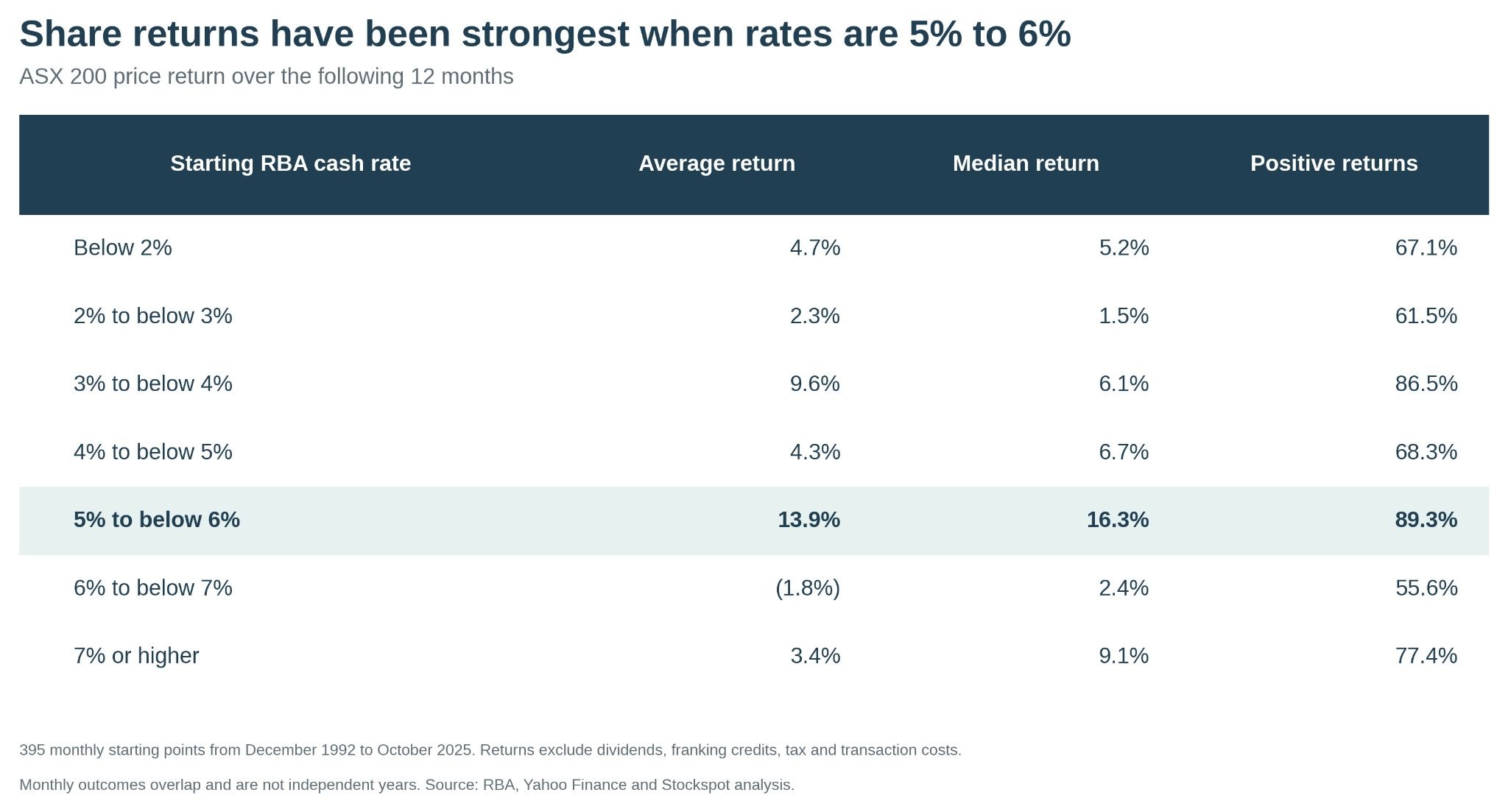
The returns when interest rates were between 5 and 6 per cent dwarf every other interest rate range.
When the cash rate was between 2 and 3 per cent, the average forward return was only 2.3 per cent. Below 2 per cent it was 4.7 per cent.
Why 5–6% interest rates could be the Goldilocks zone for shares
One reason for this may be that low rates are often a response to an economy that’s struggling. Cheaper borrowing can help but it may take time to flow through to company profits, particularly when businesses and their customers are worried about the future.
Rates between 5 and 6 per cent may be the “Goldilocks zone”, where the economy’s still strong enough to support profits, but rates haven’t risen far enough to break borrowers and household spending. Not too cold, not too hot.
In that range, banks can benefit from stronger nominal growth while the big miners like BHP enjoy rising commodity prices. And other businesses still have enough pricing power to pass higher costs on to customers – something many of us seem to be experiencing with credit card surcharge costs.
There have been several examples over the past 35 years.
The cash rate sat between 5 and 6 per cent for parts of 1992 and 1993 and the share market rose strongly in 1993.
Rates came back into this range during 1997 and 1998. Shares rose in both years despite the Asian financial crisis, so investors who waited for things to calm down before investing would have missed out on those gains.
The longest stretch was from late 2003 to July 2006, when the RBA gradually lifted the cash rate from 5 to 5.75 per cent while Australian shares continued to climb. The China commodity boom and a strong global economy helped Australian shares post double-digit gains through much of that period, even as borrowing became more expensive.
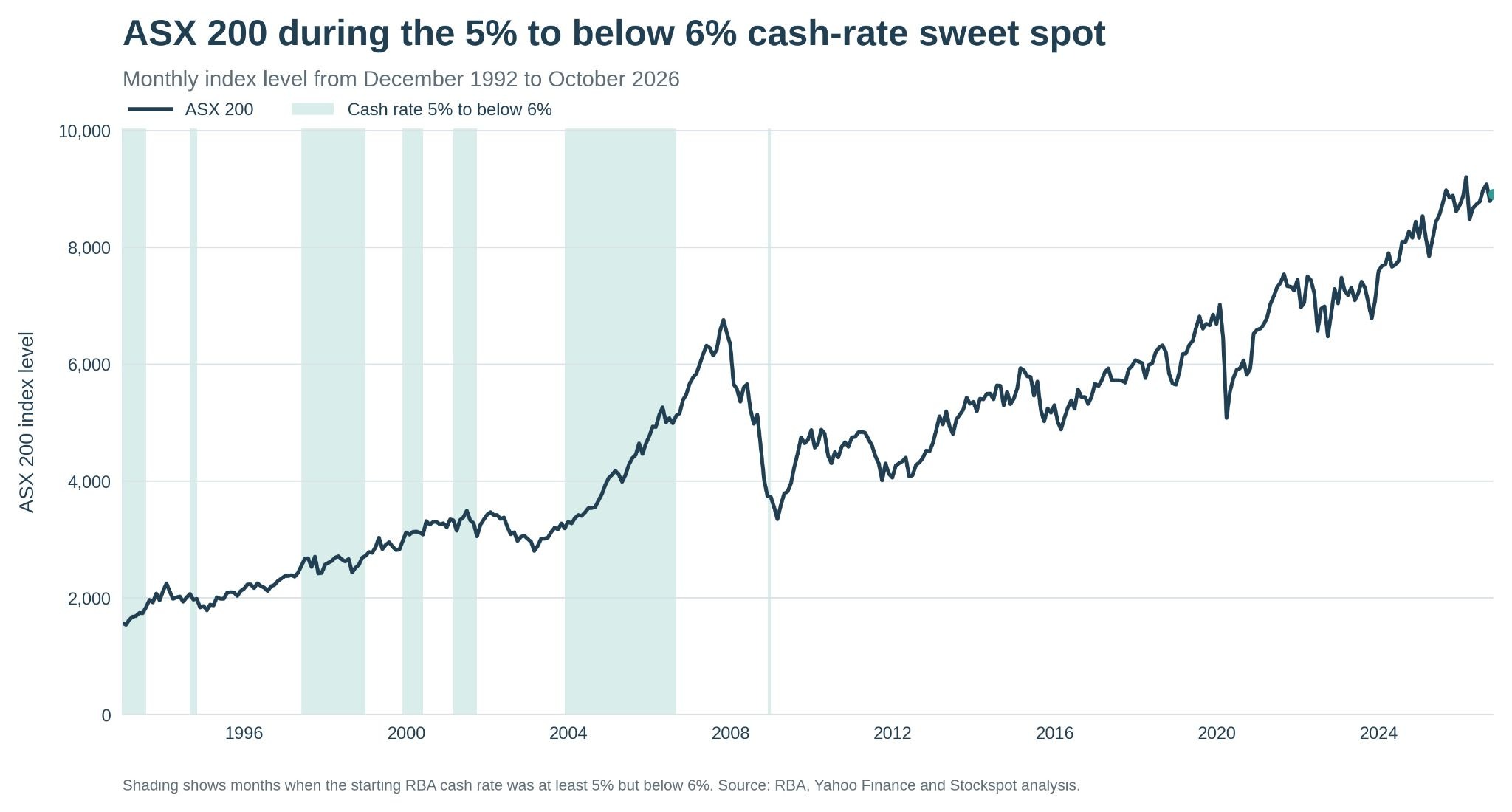
What happens when interest rates rise above 6%?
Things changed once the cash rate moved above 6 per cent. Debt servicing costs became more restrictive and the share market eventually ran into the GFC (global financial crisis).
Historically, when rates were between 6 and 7 per cent, the average 12-month return was negative 1.8 per cent. That seems to be the point where households and businesses started to crack.
What might it mean for shares?
The cash rate is currently 4.85 per cent. Another 25 basis point increase in December would take it to 5.10 per cent and put Australia inside this historical “Goldilocks zone”.
The ASX 200 is currently around 9,100 points. Applying the historical average gain of 13.9 per cent would put the index at roughly 10,400 points by late 2027.
There are other reasons Australian shares could surprise investors to the upside in 2027.
The new capital gains tax rules improve the relative appeal of shares compared with established investment property. The changes also favour income over capital growth, which could encourage investors to hunt for dividend-paying companies.
That could push some would-be property buyers to reconsider Australian shares and ETFs instead.
Cash savings and mortgage offsets do have an important role in a financial plan; we tell clients to use them for emergency savings and money they’ll need over the next few years. But if you’re investing for the long term, I wouldn’t point to a savings rate above 5 per cent as a reason to move to cash instead. Our research suggests those higher rates have often been accompanied by share market returns that more than compensate investors for taking the risk.
While homeowners will be hoping the RBA leaves rates on hold in December, another hike should be less of a worry for share investors. An ASX 200 above 10,000 points in 2027 could surprise those who’ve decided cash is the better place to be.
This article was originally published as an opinion piece for The Australian – ASX shares deliver strongest returns when interest rates hit 5 per cent: Stockspot (13 November 2026).