In the late 1990s I had only been investing for a couple of years. But with a few early wins behind me, I felt invincible.
The internet was exploding into the mainstream. Every company that added “.com” to its name seemed to rocket. It felt like we were watching the future unfold in real time.
I convinced myself I understood where the world was heading and put my modest savings and pocket money into a handful of companies that had reinvented themselves as internet businesses.
Profitability barely rated a mention. Growth was the only metric that seemed to matter.
Like many investors at the time, I believed that was enough.
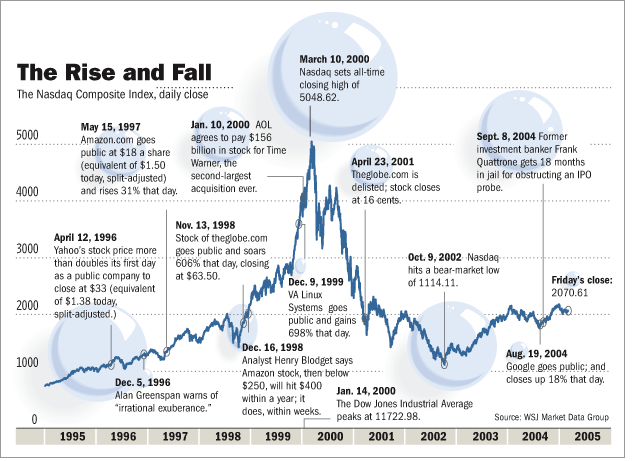
And then the bubble burst.
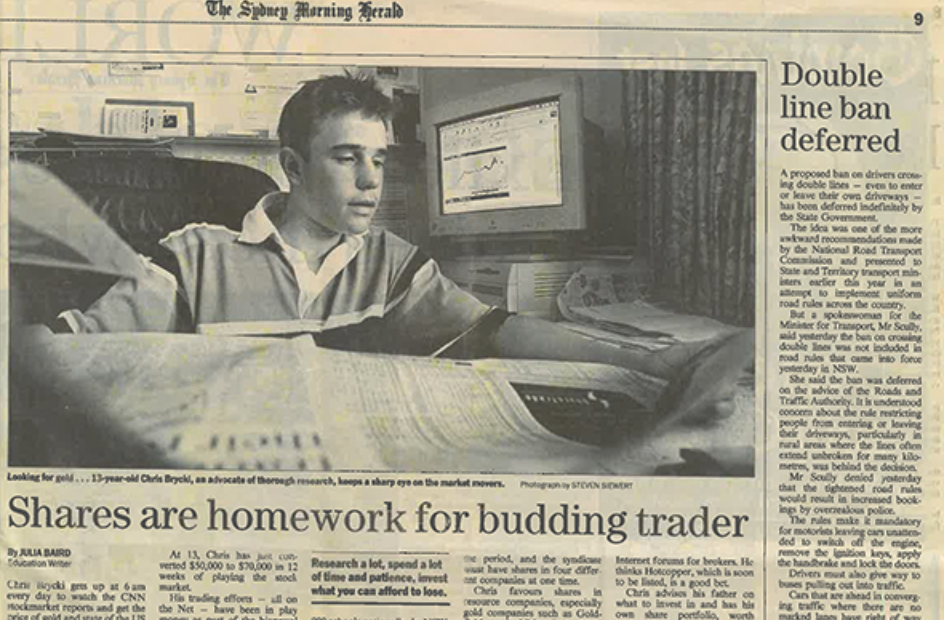
When the tech boom unravelled in April 2000, prices didn’t drift lower. They collapsed. I remember sitting in the school library refreshing the screen in disbelief as shares that had once felt unstoppable kept falling day after day.
One of the largest positions in my small portfolio, only a few thousand dollars at the time, was eMitch, later known as Mitchell Communications. It traded above $3.70 at its listing peak in 2000. Within three years it was worth just $0.026. A 99.3% decline.
On paper I had backed a powerful trend. I believed online advertising would grow strongly over the long term. That view proved right. Digital advertising went on to reshape the industry.
But markets don’t reward a good narrative on its own. They are ruthless when it comes to overconfidence and poor timing.
I had let hype override discipline and I’d concentrated too much of my portfolio in a handful of shares. Even though the dollar amount was small, it felt enormous at the time. It was my savings. It was my confidence.
Looking back, I was lucky.
I learned that lesson early – as a 14 year old kid. No mortgage – no family relying on me. I had time to recover and reflect. If I had learned the same lesson later in life with a much larger portfolio, the consequences would have been far more severe.
That experience changed how I think about risk.
Lesson 1. Position sizing and diversification matter more than conviction
At the time I believed strong conviction was the path to strong returns.
If you were confident enough, you should back yourself.
What I didn’t appreciate was how fragile a portfolio becomes when it depends on a handful of big positions. A single company can fall more than 90%, as I learned the hard way. When that happens, the recovery is not quick. It can take years just to get back to where you started.
That’s why I now recommend broad ETFs.
When you invest through a diversified ETF, you are spread across hundreds or even thousands of companies. If one fails, the damage is limited. It becomes a dent, not a disaster.
At the same time, you still participate in the winners.
Each year a small number of companies rise by hundreds or even thousands of percent. The challenge is that no one knows in advance which ones they will be. Very few investors consistently identify them early and hold them through the volatility.
An ETF captures those outliers automatically. As a company grows and becomes more valuable, it becomes a larger part of the index. You participate in its upside without having to predict it.
Importantly, the downside of any one stock is capped at 100%. The upside is theoretically unlimited. A diversified ETF allows you to harness that asymmetry across the entire market.
You limit the damage from any one mistake. You still capture the upside from innovation.
That combination is powerful.
A diversified approach means you do not have to be right about a single company. You simply need the global economy to keep progressing over time.
Lesson 2. Markets trade on expectations, and themes can run too far
The internet did transform the world.
My mistake was assuming that because something is true, it must also be a good investment at any price.
By early 2000 expectations for internet stocks had become detached from reality. Share prices already assumed years of explosive growth.
When expectations are that high, the bar becomes almost impossible to clear. A company can deliver strong growth and still see its share price fall if it fails to exceed what the market has already baked in.
eMitch was not alone. Even Amazon, which went on to become one of the most successful companies in history, saw its share price fall around 95% after the tech bubble burst.
The theme was right. The timing and the price were not.
This lesson applies far beyond the tech bubble
Every few years a new theme captures attention. It might be software… lithium… private credit, silver or artificial intelligence. The narrative becomes compelling. Media coverage intensifies and money flows in.
I have become far more cautious when a theme becomes widely accepted and heavily promoted.
Markets have a habit of causing the most pain to the most people.
When something is on the front page of every newspaper and discussed in every podcast, it’s usually already reflected in the price.
At that point the risk is not that the theme is wrong. The risk is that expectations are too high.
If reality turns out to be simply good rather than spectacular, prices can still fall.
That don’t mean avoiding innovation and change altogether. It just means avoiding too much exposure to any one sector of the market.
A diversified portfolio allows exposure to new trends without betting the house on them. It reduces the temptation to chase what is hot. It keeps you focused on long term compounding rather than short term excitement.
Lesson 3. Your time horizon needs to match the risk you’re taking
I told myself I was a long term investor.
In reality, my portfolio was not structured to survive the volatility that comes with concentrated share bets.
A genuine long term strategy is not just about patience. It’s about design. Your portfolio should be built so you can stick with it when markets fall 50% or more.
Diversification and disciplined rebalancing make that possible.
My best investment was not a share
The irony is that my best investment has not been a single share.
It has been automating my investing and removing myself from day to day decisions.
By using a disciplined, rules based approach with automatic rebalancing, I no longer react to every headline. My portfolio and super are adjusted when needed, without emotion.
That has freed up something far more valuable than returns.
It has given me time.
More time with my family. Less stress. And the confidence that my investments are working quietly in the background while I focus on the things that matter most.
I explained why time is my most valuable asset in this video.
I was lucky that my worst mistake didn’t destroy my finances. It improved them.
I learned that long term success doesn’t come from chasing the next big theme. It comes from diversification, discipline and humility.
This article is adapted from an opinion piece published by the ASX– What I learned from my best and worst investments (6 February 2026).