Over the 12 months to 30 June 2026, the five Stockspot Model Portfolios delivered after fee returns of 9.7% to 14.7%.
Markets were shaped by conflict in the Middle East, persistent inflation, changing interest rate expectations and continued excitement around artificial intelligence. Different investments within our portfolios performed well at different times.
Stockspot portfolio performance
Our Topaz High Growth Portfolio returned 14.7% after fees over the year. Emerald returned 13.0%, Turquoise returned 12.2%, Sapphire returned 10.8% and Amethyst returned 9.7%.
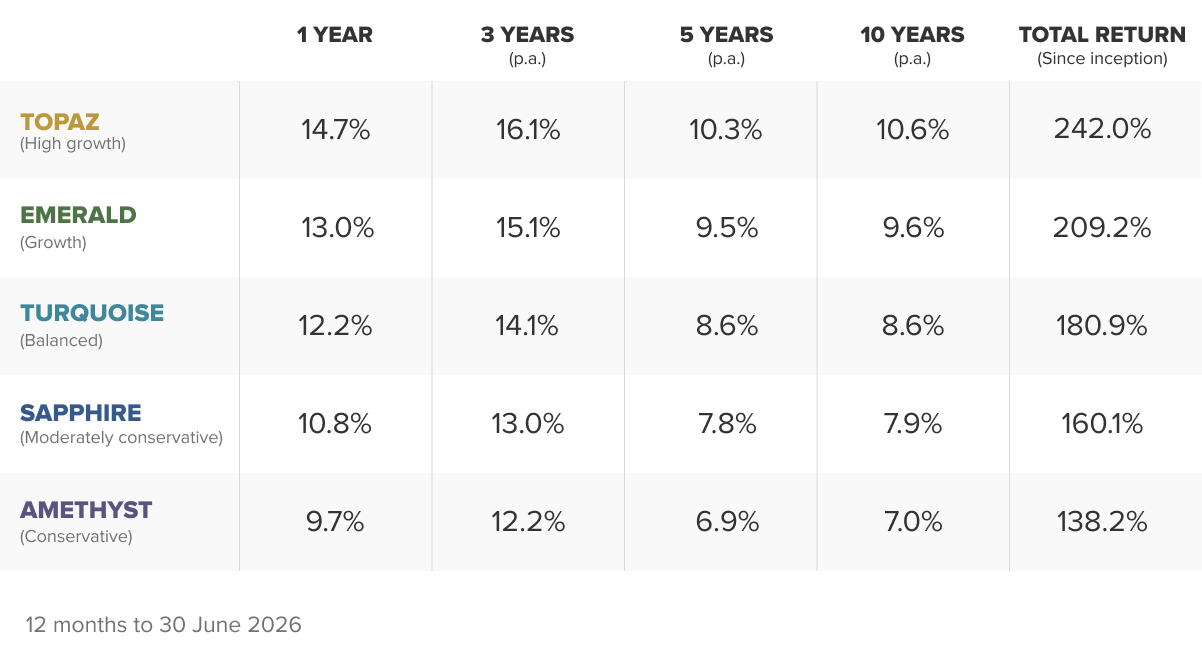
Longer term returns remain strong. Topaz has returned 10.6% per year after fees over 10 years. That’s a total return of 242.0% since inception.
Emerald has returned 9.6% per year over 10 years. Turquoise has returned 8.6% per year. Sapphire has returned 7.9% per year and Amethyst has returned 7.0% per year.
Over the past decade to 30 June 2026, our model portfolios have outperformed 269 out of 269 comparable diversified funds across the Growth, Balanced and Moderate categories (100%)^
These results reinforce a simple point. Successful investing isn’t about predicting every market movement. It’s about staying diversified, keeping costs low and allowing compounding to do the heavy lifting.
Our Topaz Inflation Portfolio returned 33.4% over the 12 months to 30 June 2026, following its exceptional 50.4% return in 2025. It’s come off the boil more recently as gold, silver and gold mining shares retreated from their highs. That’s normal after such a strong run and highlights why returns shouldn’t be judged over short timeframes.
Our Topaz Income Portfolio also delivered a strong 20.6% return over the year. Its higher allocation to Australian dividend shares benefited from growing investor demand for established companies paying reliable income.
Strong performance compared with similar funds
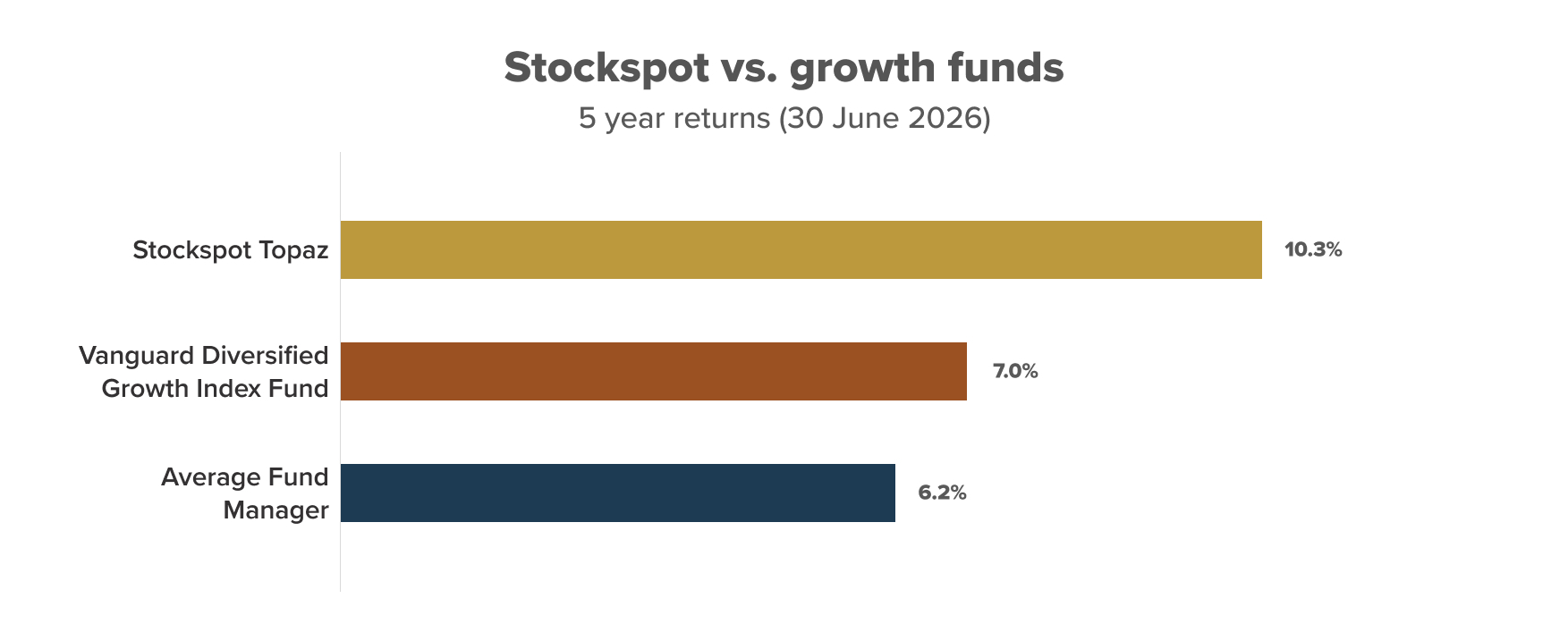
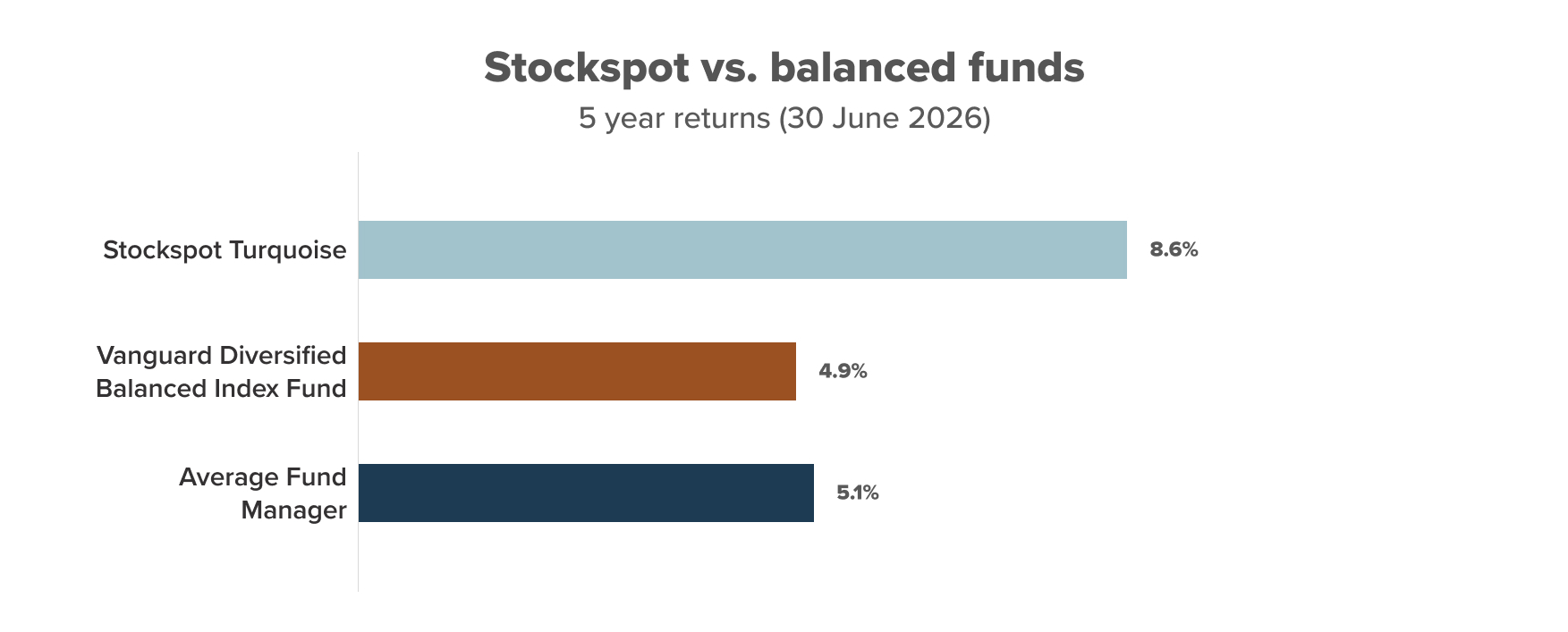
The Stockspot portfolios also continued to perform strongly compared with similar risk diversified funds over five years.
Our Topaz Portfolio returned 10.3% per year over five years. That compares with 7.0% per year for the Vanguard Diversified Growth Index Fund and 6.2% for the average growth fund manager.
Our Turquoise Portfolio returned 8.6% per year. That compares with 4.9% for the Vanguard Diversified Balanced Index Fund and 5.1% for the average balanced fund manager.
Our Amethyst Portfolio returned 6.9% per year. That compares with 3.1% for the Vanguard Diversified Conservative Index Fund and 3.7% for the average conservative fund manager.
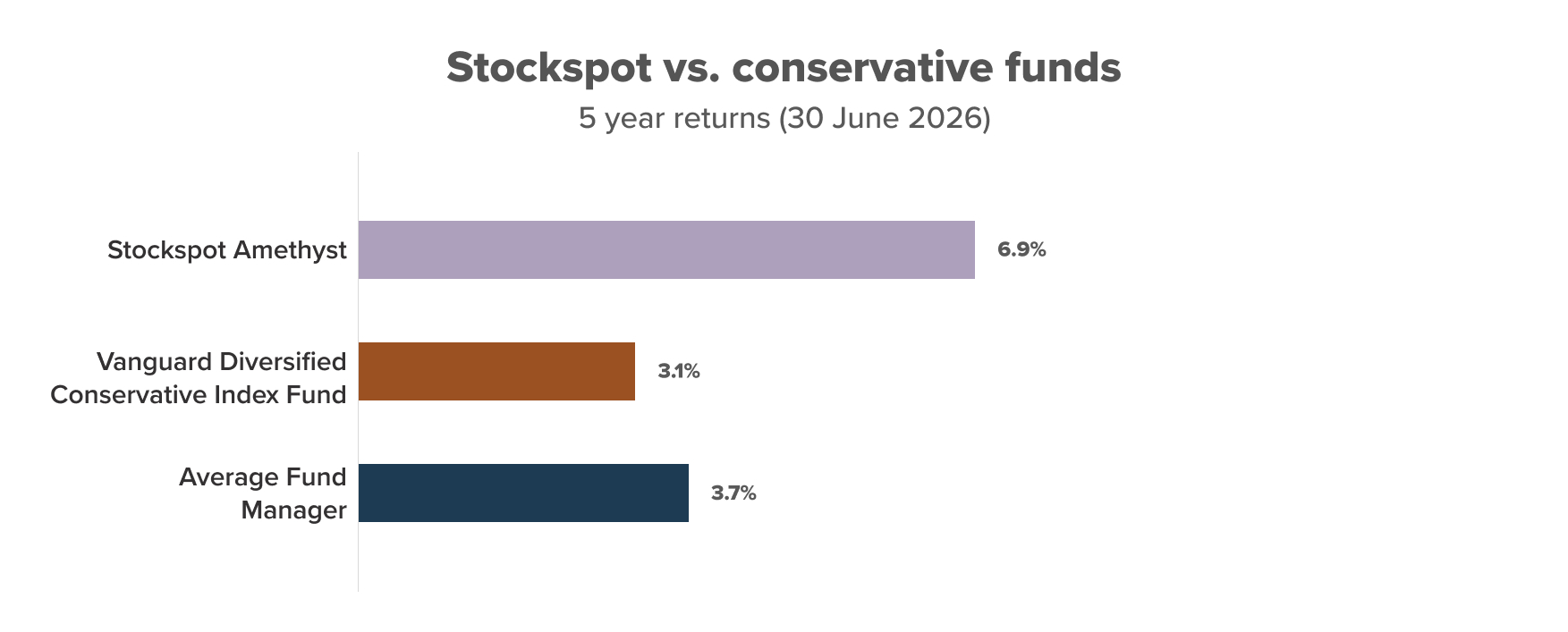
A difference of three or four percentage points each year may not sound dramatic. Over time it can have an enormous impact on how quickly wealth compounds.
Returns by asset class
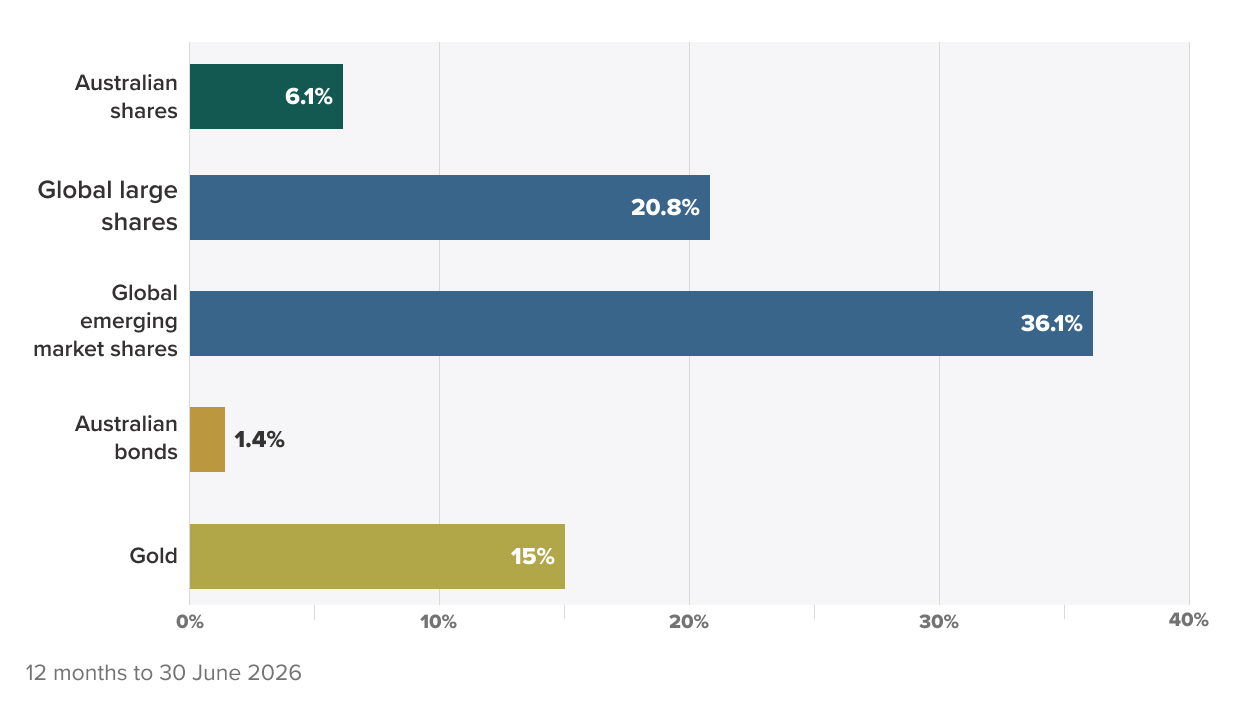
Our relatively high allocation to emerging markets was an important contributor to returns. Global shares and gold also delivered strong gains. Australian shares and bonds produced more modest returns.
Emerging markets lead the way
Emerging market shares were the standout performer over the year. Our emerging markets ETF returned 36.1%.
Asian technology companies were among the strongest performers globally. They benefited from growing investment in artificial intelligence, semiconductors and digital infrastructure.
Markets including South Korea and Taiwan were major contributors while India also performed well. Chinese shares recovered as investors focused on spending on semiconductors and AI infrastructure.
For several years, emerging markets lagged developed markets and were unpopular with investors. This year was a reminder of why we continue to hold them.
The best performing market changes over time and investors who concentrate only on the recent winners risk missing the next source of returns.
Our relatively high emerging markets allocation helped Stockspot portfolios perform strongly compared with many similar diversified funds over the year.
Global shares
Our Global 100 ETF returned 20.8% over the 12 months.
Large technology companies continued to benefit from excitement around artificial intelligence. However, returns began to broaden beyond the largest US companies. Healthcare, financials, industrials and consumer staples also performed well. A wider range of companies contributing to market returns is generally healthier than relying on a small group of technology businesses.
Australian shares
Our Australian shares ETF returned 6.1% over the year.
The local market trailed several overseas markets. This partly reflects Australia’s lower exposure to technology and the companies benefiting most from AI investment.
Australian shares still played an important role in portfolios. They provided income, franking credits and diversification from overseas markets.
Bonds
Australian bonds returned 1.4% over the 12 months. Bond markets remained volatile as investors repeatedly changed their expectations for inflation and interest rates.
Australian inflation has remained more persistent than expected. Strong employment, resilient consumer spending and higher energy costs have delayed its return to the Reserve Bank’s target range.
The annual return was modest however, bonds continued to provide income and helped reduce portfolio volatility during periods of sharemarket weakness.
Gold
Gold returned 15.0% over the year and remained an important contributor to portfolio performance. Geopolitical tensions, government debt, inflation concerns and central bank demand continued to support the gold price, despite it falling from its January highs.
Volatility rewards discipline
The conflict in the Middle East showed how quickly markets now process new information.
Oil prices moved by 5% to 10% on some days. Sharemarkets initially fell by around 10% before rebounding towards record highs as the conflict eased.
Many large super funds responded by repositioning their portfolios: some increased shares, others raised cash or made tactical changes based on geopolitical developments.
They may not describe this as market timing, but that’s effectively what it is. The challenge is that markets now react within hours. By the time a portfolio has been repositioned, the opportunity has often passed.
Investors who sold after markets fell risked missing the rebound. Those who made large defensive changes after gold had risen may also have been caught by its recent decline.
Our approach is deliberately different: we don’t try to predict short term headlines. We build diversified portfolios that can withstand a wide range of outcomes and we then rebalance them systematically.
What the proposed CGT changes could mean
The Federal Government’s proposed capital gains tax changes may significantly alter investor behaviour from 1 July 2027.
The proposed system treats gains and losses differently. Investors holding direct portfolios with a handful of large winners and many smaller winners or losers could pay considerably more tax than they do today.
Broad market ETFs may become even more attractive. They pool hundreds or thousands of investments together. This helps smooth the impact of individual winners and losers. ETFs also tend to trade less frequently than actively managed funds, which can mean fewer capital gains being passed through to investors.
The changes may also encourage investors to favour established dividend paying companies over smaller growth businesses. That could direct more capital towards the banks, supermarkets and infrastructure companies that dominate Australia’s major sharemarket indices. Less capital may flow to startups, small companies and emerging businesses.
The administration will also become more complicated. A self managed portfolio of 20 shares could require around 10,580 tax calculations each year under the proposed rules. That compares with approximately 1,280 calculations today.
Stockspot will continue to manage the calculations, record keeping and tax reporting for clients. Whatever happens to the rules, our aim is to keep investing simple.
More improvements for clients
We’ve continued improving the Stockspot experience during the past six months.
We launched recurring deposits using PayTo. This makes it easier to automate regular investments while keeping control through your Stockspot dashboard.
We also launched Stockspot Pension. It provides a simple and transparent way for investors to turn their superannuation savings into retirement income or begin transitioning towards retirement.
These improvements support the same philosophy that has guided Stockspot since 2014. Good investing should be diversified, low cost, tax efficient and easy to maintain.
Looking ahead
Markets have largely been treading water over the past few months. Periods like this are normal and can test investors’ patience. Returns tend to be bunchy rather than arriving smoothly, so investors need to stay invested to capture the relatively short periods when markets deliver most of their gains.
The second half of 2026 is likely to bring more market uncertainty.
The conflict in the Middle East could escalate again. Inflation remains above target and interest rate expectations are changing quickly. Investors are also weighing the enormous amounts being spent on AI against the earnings those investments may eventually produce.
Nobody knows which of these themes will dominate markets next however the past year showed why investors don’t need to know. Emerging markets, which many investors had ignored, became the strongest performing asset class in our portfolios. Gold rose strongly and then fell sharply. Shares recovered from geopolitical shocks before most investors had time to react.
Markets reward patience, not prediction.
Our job is to keep portfolios diversified, control costs, rebalance sensibly and help clients stay invested through the noise. That approach has delivered strong results over the past year. More importantly, it has continued to work over 10 years and across many very different market conditions.
^ Stockspot, https://morningstar.com.au comparison group of 269 surviving investment funds and their after-fee returns over the 10 years from 1 July 2016 up to 30 June 2026. Comparison is based on the after-fee returns of a Gold tier investment in either Stockspot Amethyst, Turquoise or Topaz portfolios (our most popular portfolio in each risk category) on the basis that they have similar exposure to growth assets to the moderate, balanced and growth multi-sector investment funds that have been compared. Past performance is no indication of future performance.